
RSRA: "Record Search with Risk Assessment" – Lender Guidance from SBA
Environmental due diligence is like baking a cake – it only works if you follow the recipe. Learn the smart lender's secret to making their cakes come out great every time. Happy customers are the icing on top.

Environmental due diligence for commercial real estate lending has changed a lot in the last few years.
Small Business Administration (SBA) lending has taken on an even greater role than in the past. And even for non-SBA lenders, SBA's policies and procedures have a new significance: non-SBA lenders can benefit from the policies that SBA has used and perfected over many years.
SBA has taken a leadership role in establishing common-sense environmental due diligence policies and procedures for lenders. It introduced faster, less expensive tools like the Records Search with Risk Assessment (RSRA), along with protocols for proper use.
Many vendors have their own names for the RSRA report, but they are mostly variations on SBA's theme, tailored in some cases to the needs of individual institutions.
These RSRA reports are quick and inexpensive enough to be incorporated into nearly any loan process without souring the deal. And while they do not take the place of the Phase I ESA, they can often help determine whether an expensive Phase I is needed.
They are perfect for smaller lenders and credit unions who lend on commercial real estate but do not have in-house environmental staff, and want to keep their people focused on making deals instead of getting off into the environmental weeds.
Apply the Pareto principle
For most lenders, most of the deals you see are going to screen out as "low-risk". You could figure 80/20 and probably not be wrong. The problem is, you do not really know which ones are going to be a problem and which ones are going to be fine until you actually screen them.
Having performed thousands of these screens, we can vouch for this. You cannot always tell just by looking. We once had a CDC client who was backing the purchase of an empty big-box retail location. He had already approved the deal when he ordered the environmental screen from us, almost as an afterthought. He was shocked when we had to tell him that it had previously been a plating facility, and had undergone more than 20 years of environmental remediation and legal wrangling before it was repurposed as a "brownfield" in the 1990s. And there was still contamination present.
I could regale you with scores of stories like this. But you get the picture. Process matters. If you try to skip steps, you can – and eventually will – get burned.
Here is the basic SBA environmental process flow chart:
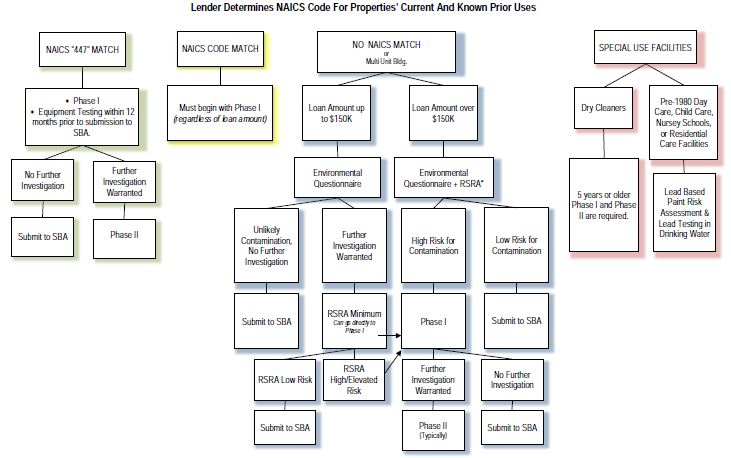
A useful matrix for lenders to manage environmental risk. Not just SBA lenders, either. This is a great lending policy template for any lender, especially smaller ones.
Important takeaway: SBA's policy guidance can also be applied to non-SBA lending, and can be customized or tailored to the needs of each lender. In terms of thoroughness, the SBA process is probably more than sufficient for most lenders' needs.
SBA guidance
On April 3, 2018, Mr. Stephen Olear, SBA's lead attorney on environmental policies at the time, presented a thorough explanation of the steps to perform environmental due diligence on SBA-guaranteed loans. Here is a summary of the basic environmental due diligence steps lending institutions should follow; the current edition of the rules is SOP 50 10 8.1, effective October 1, 2026.
- Is the loan secured with commercial real estate? If yes, some level of environmental due diligence is required.
- Is the commercial real estate's current or past use on the list of "environmentally sensitive industries"? If no, proceed with the minimum step for that loan size. If yes, you must begin with a Phase I environmental study. The report must be submitted to and approved by SBA prior to loan disbursement (PLP and Express lenders can use delegated authority).
- Is the loan under $150,000? If yes, and the property is not identified as environmentally sensitive, you may begin with an Environmental Questionnaire.
- If the loan is over $150,000 and the property is not on the list of sensitive industries, you must begin with a Records Search with Risk Assessment (RSRA). You should still have the current property owner complete an Environmental Questionnaire on the subject property.
- On completion and review of the RSRA, follow the recommendation of the provider. If the report indicates no further action is required, send a copy to SBA underwriting for concurrence (PLP and Express lenders can use delegated authority). If the report recommends further investigation, the lender must follow the guidance provided, usually a step to a Phase I environmental review.
Remember, there is no need to pay $1,000 – $4,000 and wait two to four weeks for a Phase I on every deal, especially when the savvy lender down the street is screening most of their deals within just a few days, for a few hundred dollars.
Pro tip: make sure whoever does your environmental screening guarantees that you will not get upsold and "double dipped" if a potential environmental issue is discovered in the screen. This is much more than just getting reimbursed. A guarantee means you never have to wonder whether there was a conflict of interest for the environmental consultant. Here is how a guarantee eliminates those conflicts.
Main benefit: your institution avoids the potential costs and risks that often stem from financing a property with unforeseen environmental contamination.
Bonus: borrowers will understand that the environmental due diligence you require as a lender also protects their investment in the asset.